Sunday, May 2, 2010

Creature Comforts

When in doubt about where you are and what you're doing, find something to fixate on.  That's what I did in on the Peloponnese and these were the things I found.
Right outside my hotel room in Olympia.
Gouda special from Pizza Hut, omg
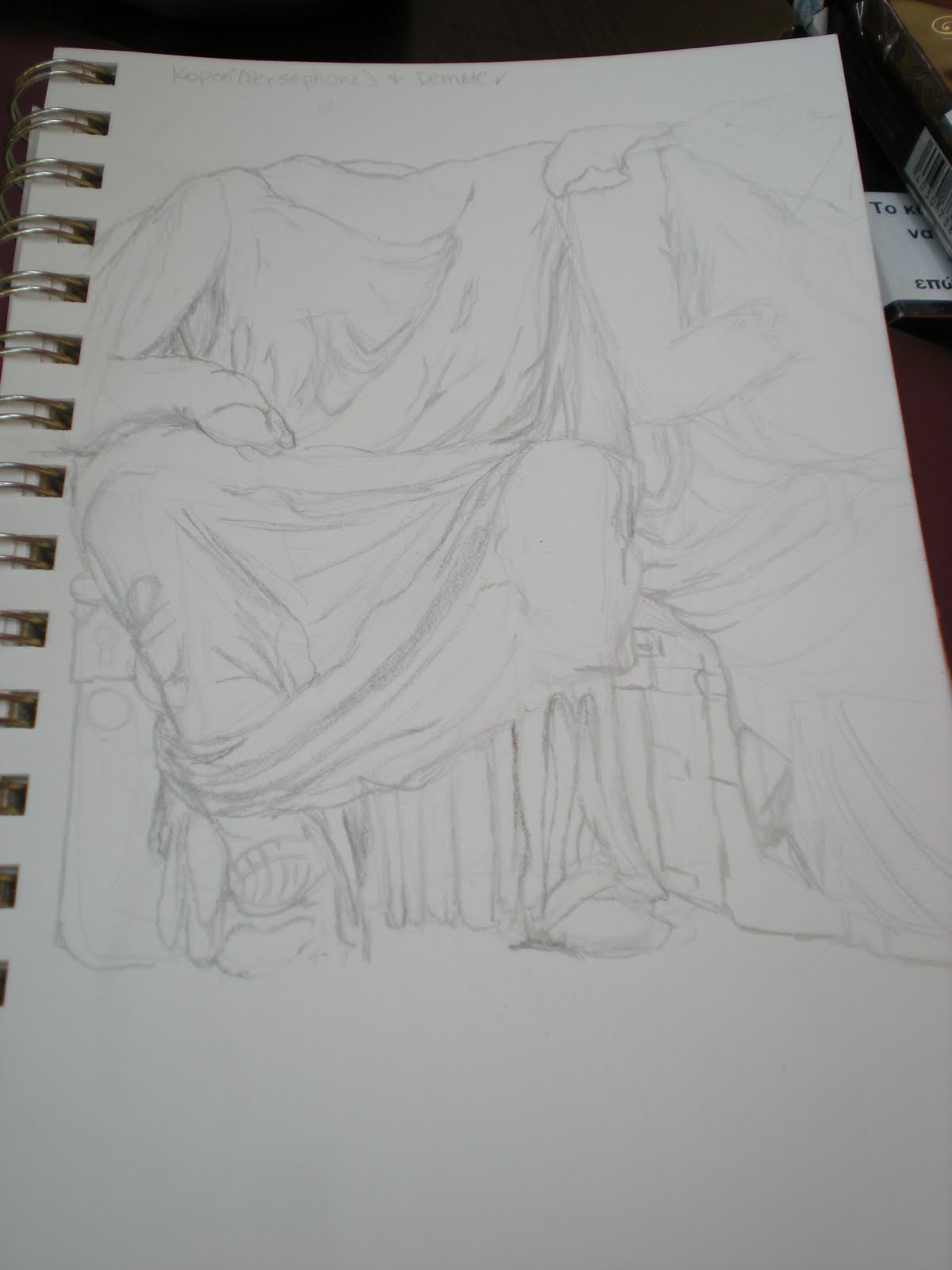
More sketches from the Acropolis Museum (not really Peloponnese but still counts)


Flowers growing out of rocks at the Venetian Palamidi Fortress


More pics from Mycenea

wtf Olympia why do you have a phone next to the shower?
Peloponnese waters clear as day (the black things are sea anemones)
 Me + Peloponnese coast (it was really really hard not to squint, it was so bright outside!)
Beetle snagged at Delphi


My true desire in snapping this pic was getting a peak at the blue beetle on the left.  Did you know the color blue is the hardest to recreate in nature? It takes a very specific and sustainable ecosystem to support species that exhibit the color blue, both in plants and animals.

More wildflowers


Greetings fro Olympia!


I have to say.  I love love love Olympia.  The town is centered around the ancient Olympic Stadium and the Temple of Zeus and Hera.  In ancient times, it was forbidden for anyone to live at the site or in the surrounding area except for priests, with the exception of the 8 day festival of the Olympic games, held once every four years, when thousands of people would come to witness the athletic competitions.  All warfare among Greek city-states temporarily ceased at that time, under the premise that athletic ability could be used to show superiority of the different city-states instead of death.

The ground was literally littered with massive drums for the columns from the temple of Zeus.  It's difficult to show exactly how large these drums actually were, but they were easily five feet wide, and you could climb all over them.  This temple of the most grandiose of all the temples made to honor one single god and people from all over Greece would travel to pay homage before competing.


These arches were the entrance into the Olympic stadium.  So imagine entering this tunnel about 90 feet long.  As you're walking through you're taking off all your clothes and immerge into the stadium, naked, to a crowd of thousands of screaming spectators, the ruling class of all of Greece, and the only woman allowed to watch the games, a priestess considered to be the goddess of Hera in human form.


Some of the class decided to race.  The guy in the khakis and the guy behind him is Andrew and Bob, respectively, our faculty.


Olympia, Greece has Evergreens too.


This picture gives you an idea of how pediments looked.  Pediments were placed on tops the different sides of temples.  In the highest nd most central point of the pediments, usually a god was placed, dictating some action to be done amidst scenes common to Greek myth.  From there, both the physical and symbolic positions and significance of various figures would gradually decline until you had humans kneeling or crouching at the ends of the pediments, typically reacting to the situation being presented rather than partaking in the action.

These women are the farthest left on the pediment pictured above, crouching in fear of the Centaurs.

These statues come from one of the pediments of the Temple of Zeus, depicting the Battle of Centaurs and Lapiths.  The imagery of Centaurs isn't considered a literal artistic representation, but rather a metaphor of the barbarous nature of foreign peoples, using half-animal, half-human motifs to express superiority of Greeks over their more animalistic natures of their neighbors.  The story goes that the Greeks invited Centaurs to celebrate the wedding feasts of Pelops to the princess of the Lapiths.  The Centaurs proceeded to get sh*t-faced and began raping the women and fighting the men.  Apollo (not pictured but just the right of these statues) is ordering Pelops to kill this Centaur, who is fondling the princess, Pelop's bride.


This is the status of Apollo and Dionysus.  The legend goes that Zeus ordered Apollo to hide the half-man, half-goat bastard demigod from his wife, Hera, so Apollo wrapped him in a blanket to hide his goat features and stole him away to the countryside to be raised by nymphs in the mountains.  The assumption is that Apollo is taunting Dionysus with a bunch of grapes because, naturally, Dionysus grows up to become the deity of wine and drunken tomfoolery.


::giggle::


Statue of Nike, goddess of victory.  Yes, the shoe company was named after her.  In her original form, she would have been double her height here, about twelve feet tall counting her wings, and topped on one of the temples here.


Well, I've got the big test in an hour and a half and then flying off to Florence tomorrow.  May update later if I have a chance.  Hopefully our apartments will have wifi.  And I will have a kitchen.  Hurray!

Saturday, April 24, 2010

And now for something different

All the museum stuff can dry and overwhelming, so here's a little more color:


View from Hotel Napflion at sunrise this morning (10:15pm Oly time)


Elementary school across the street from hotel roof


Elementary school roof


View from the top of the Palamidi Fortress


Ocean view from Palamidi Fortress


Yet another stairway leading to nowhere


Chains to keep us out of one of the bastions under renovation


Just to get an idea of how far we were form the ground.  That's Ian down there (I think)


Intrusive lamps for your nighttime viewing pleasure


I don't know what kind of plants these things were, but they were awesome!
A grain of some kind?


More flowers


A family of dogs lives up at the Mycenean site we visited and they just had puppies!


As soon as it's feasible, I'm getting a dog when I get back home.


Overall today was good.  Visited a few sites.  Been taking some down time at the hotel until going to a wine tasting in half an hour.  And tomorrow, I visit Olympia! (Greece, not WA)

Friday, April 23, 2010

Greece in video

shot on one of the buses in Crete coming back from the Palace of Knossos:


crete from Kristina Williams on Vimeo.

The quality is a bit shoddy, I apologize. It's Vimeo's fault, not mine.

Magic Numbers: 14-41-11

I've been in Greece now for 15 days. 15 days feels like a lifetime.  And there's no time to stop, so we haven't.  We haven't had any free days since class started and I'm exhausted.  We were supposed to have one in Chania, but that got cut because of the strikes.  The free day was then tacked on to Athens, but we had seminar that day and the day after that was also supposed to be free, but we had Latin that day instead (again, because we had to rearrange the schedule).

On my fifth hotel stay, seventh if you count the overnight ferry rides.  I know my teachers are just trying to expose us to as many the different things as possible, but it's a bit overwhelming.

For class, we will be:

Traveling to 14 different cities
Athens x4
Heraklion
Chania
Nauplion
Epidaurus
Olympia
Delphi
Florence
Duomo
Volterra
Siena
Fiesole
Pizza
Lucca

Visting 41 different sites/museums
Monastiraki (Athens)
Acropolis
Mt. Lycabettus
Acropolis Museum
Tomb of Kazantzakis (Crete)
Archaelogical Museum of Heraklion
Gortyn
Palace of Knossos
Palace of Phaestos
Agia Triada
Matala
Malia
Tilissos
Chania Museum
Hania Museum 
Corinth Museum
Acrocorinth
Mycenea Museum
Palamidi Fortress
Epidaurus Museum
Epidaurus Theater
Epudaurus Site
Olympic Games Museum
Ancient Olympia site
Archeological Museum of Olympia
Delphi upper site
Delphi lower site
Osios Loukas Monastery (Pellepenese)
National Museum of Greece (Athens)
Renaissance Florence (Florence)
New Market
Piazza della Signoria
Altra' Arno
Church of Santa Maria Novella
Church of San Lorenzo
Duomo interior (Duomo)
Baptistery
Duomo Museum
Monastery of San Marco
Accademia Museum
Fiesole Etruscan ruins
Uffizi Art Galleries

Staying in 11 different hotels/accommodations
Art Gallery Hotel x3
Minoan Lines Ferry x2
Hotel Olympic
Hotel Kydon
Nauplion
Ilis Hotel
Hotel Acropole
Florence Apartments

Okay! Time to start utilizing Google Calendar!
Just got into Nauplion. I'm exhausted. Good night.

Thursday, April 22, 2010

Crete Day 3

Okay, finished Latin, finishing up my posts before the long long days ahead of me in Corinth and Delphi.

Crete, Day 3, Sunday, April 18
Minoan Palace of Phaestos, Agia Triada and Matala
Giant groves of giant olive trees outside of Phaestos.  I've decided that wherever I live I want to have olive trees.  They are just so damn regal.


More storage jars at the Palace of Phaestos


Agia Triaga, used to be an agora, an outdoor public place with shops and such.  Those giant square stone-looking things used to be round wooden columns.


Okay, so this probably doesn't look terribly impressive, but this was the one of many underground plumbing systems used in the different palaces we visited.  There were actual streams of both fresh water being brought into the palaces and waste water being taken out of the palaces under the floors.  Controlled the flow with a series of levers and pulleys.  This one is pretty rudimentary, but just keep in mind this is over 2,000 years old, and it still works!  They also had actual terracotta pipes too.


View from lunch in Matala.  The little ants swimming down there are classmates, and I think Andrew too (one of the professors)

Crete days 1 & 2

So I'm exhausted.  Enjoying my second free day back in Athens, the last for a while and I didn't realize how exhausted I was (am).  The ride on the ferry back was rockier than on the way over and I had land-sickness for the better part of yesterday.  Slept from 10am - 5pm, and then slept some more from 10pm-8am.  I've lost all sense of what day it is, so this post and the few to follow are in effect, a partial effort to reorient myself back to, you know, reality.

SO
Friday, April 16th
A pretty boring day altogether.  Got off the ferry.  Got familiar with Heraklion and visited a few Minoan villa sites from .  Not a terribly great place.  Capital of the island of Crete after dictatorship was removed from power back in the 70's I think and the capital was moved from Chania (Hania).  Lots of students staying at the hotel we were at--lots of noisy students, mostly from high schools in Italy and America.  Very touristy in a very kitch sort of way.
This is some of the pottery from the Minoan villa.  Storage jar of some kind, ~4ft. wide, 4.5 ft. tall.  Possibly used to stare grain or wine. Designs on the jars made with rudimentary tools, date approximately 3600 years ago.


Not allowed to take any the of the rocks or pottery pieces from the site, but there was a beautiful poppy field next door we were allowed to pick flowers from.


Heraklion is right on the sea on the north side of the island, and it had not one, but two city walls (inner and outer) to protect itself, and apparently one hell of a navy army back in the day.  Heraklion has grown now so that the walls only separate the inner city from the outer city.  There's only four entrances into the inner city and the actual harbor, one pictured here, built some time in the 1700s I think.


One of my roomies Dani at a fast food joint back in Heraklion.  Fast food is notoriously glam here.  She's either mean muggin' some girl who gave her a dirty look or is looking longingly for her cheeseburger, one of the two.


Saturday, April 17
Minoan Palace of Knossos (Gnossos) and Archeological Museum of Heraklion


Knossos was fantastic.  It's where the myth of the Minotaur and the Labyrinth comes from (see other post). 

Much of ruins uncovered to Knossos have been restored, a contemptuous order of debate among those in the archeological field, but, in my opinion, it was a nice change in pace from photographing rocks.  Here was what would have been considered the throne room of Knossos.  The griffins pictured were a common motif in Knossos, with the head of an eagle (meant to represent Zeus and the Heavens), body of a lion (meant to represent the earth) and the tail is actually supposed to be a snake (meant to represent the Underworld). The date of this restored wall painting is between 4,000 and 3,600 years old.

More restored artwork from the Knossos palace.  Lots and lots of art discovered from this site shows sea life, so dolphins, starfish, fish, squid, octopus, you name it.


Look.  It's a pot.


Although this is a poor portrayal, The Palace of Knossos was freakin' HUGE. The building itself was ~20,000 square meters, about five acres with about 1,500 rooms divided among four or five stories. Keep in my mind how long ago this was, about 4,000 years ago.  And from what's been deciphered from the pictographs (no decipherable text history), the palace itself has been around at least 1,000 years before then.  THAT'S 5,000 YEARS AGO OMG


Another restored portion of the palace, one of the gates with a picture of a bull, the classic Minoan-Knossos icon.


So that was the palace.  The real treasures however, were at the Archeological Museum of Heraklion, which stored all the treasures they found at the site.  I was really annoyed the tour guide wouldn't just let us walk around and discover for ourselves.  I guess someone forgot to mention to him we've been studying these things for the better part of six months now.  But after he was done, I got to snap some fantastic pictures of what they had to offer:

These may not seem terribly impressive, but they are dated in the Neolithic time period, between 8,000 and 5,200 years ago. Most of the figurines from this time period are of the earth goddess, Mother Earth. The one in the middle is my favorite :) 


Old Palatial Period, between 4,000 and 3,300 years ago.  More utilitarian artifacts begin to immerge, like the pottery here.  Figs (left) and flowers (right) depicted.


There's nothing particularly fascinating about this piece of pottery, except that it's freakin' GORGEOUS.  Looks almost like something from the far-East, considering the design and patterning (water reeds, repeated).


Bees!  New Palatial period, between 3700 and 3450 years ago.  Ornate jewelry begins to immerge.  This was a broach or pendant of some kind.  Bees were also a big deal back then, used to make honey for trade and a mark of status in a household, etc. (click pic for enlarged detail)


Check out them tatas!  These figurines are presumably priestesses and snake handlers.  Women were sacred figures, able to give predictions into the future, mother and daughter priestesses shown here.


Okay, I know I know, this is a lot of museum stuff.  Bare with me, one last piece from the museum:

THIS is the bread and butter of the Museum in Heraklion, a discus found in the deepest regions of the Knossos palace.  The pictures are called Linear A, a form of pictography that hasn't been deciphered yet.  It's  considered to be a divining tool, although it's meaning is still unknown.  The details and quality is amazing.  You should click on the picture and check it out.

Well, I've got 20 minutes until Latin so I better get on it.  Will update more later tonight.